When AI Model Quality Isn’t Enough: The Operational Cost of Usage Limits
Claude is often praised for its reasoning and writing quality, and rightly so. But after a month of consistent, real-world usage, one constraint stood out far more than model capability: The lack of an effectively unlimited working tier....
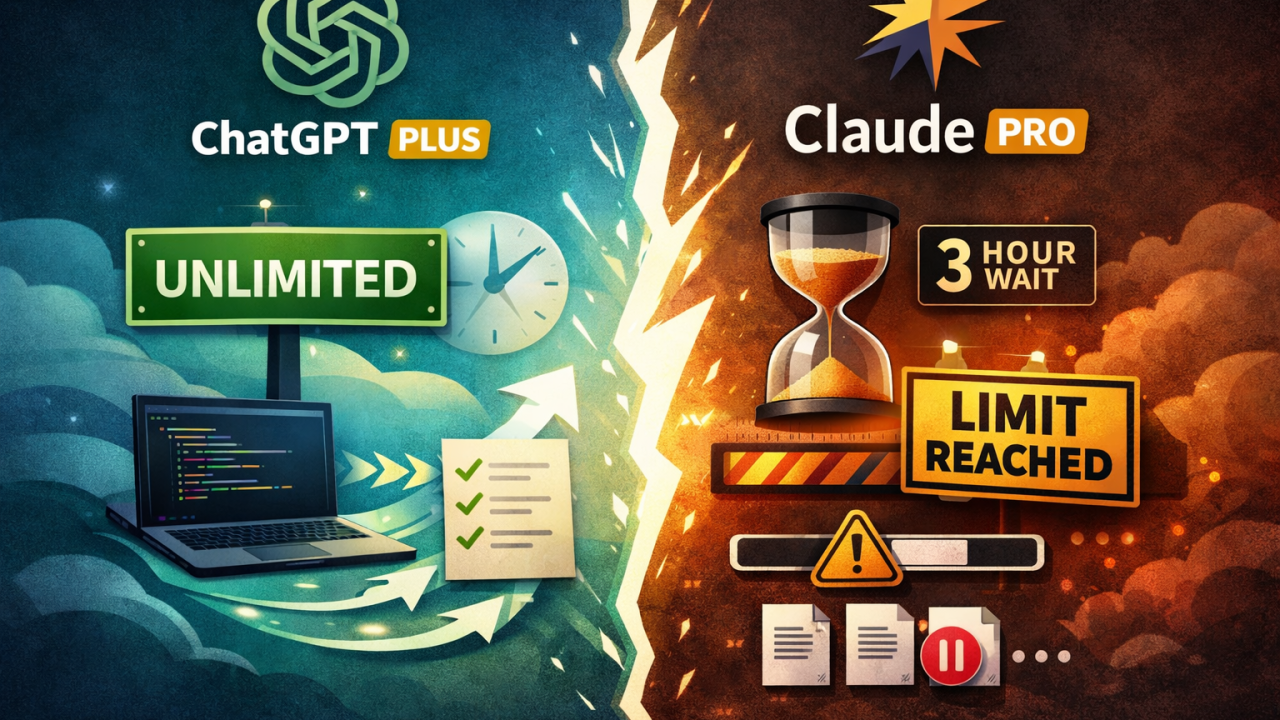
Over the past month, I have been running a deliberate side-by-side comparison between ChatGPT Plus by OpenAI and Claude Pro by Anthropic.
The goal was simple: evaluate which tool can realistically function as a primary, professional co-pilot for daily work across strategy, coding, writing, and structured problem solving.
Claude is widely praised for strong reasoning, nuanced writing, and coding performance. In many cases, that praise is justified. However, after a month of consistent usage, one operational constraint has stood out far more than model quality:
The absence of an effectively unlimited working tier.
And this changes everything.
-----
The Assumption vs The Reality
Both plans are priced similarly. On paper, this suggests parity in value.
But in practice, the experience diverges significantly once usage becomes serious rather than casual.
AI tools are no longer novelty assistants. For many professionals, they are integrated into:
- Product design iterations
- Code debugging loops
- Strategy documentation
- Long-form content creation
- Research synthesis
- Data reasoning workflows
In such environments, continuity and predictability matter as much as intelligence.
-----
The Core Friction Points
1️⃣ Predictability of Output Capacity
When subscribing to a professional tier, there is an implicit expectation: Work should not stall unexpectedly.
With stricter usage caps, the daily question becomes:
How much work can realistically be completed before the system throttles?
That uncertainty affects planning. It affects delivery timelines. It affects cognitive flow.
2️⃣ Wait Time Between Context Windows
In practical usage, the workflow often unfolds like this:
- A complex task begins
- The problem requires iterative back-and-forth
- The usage cap is reached mid-problem
- A 3 to 4 hour wait period is enforced
For exploratory tasks, this may be tolerable. For delivery-critical work, it becomes disruptive.
Momentum is lost. Context fades. Iterative thinking stalls.
And in deep work, momentum is everything.
3️⃣ Context Switching Costs
There is a hidden cost here that rarely gets discussed: Cognitive overhead.
Pausing a technical or strategic thread and resuming hours later is not neutral. It requires:
- Rebuilding mental context
- Re-evaluating previous outputs
- Reconstructing the problem state
The stronger the reasoning task, the higher the penalty of interruption.
-----
The Bigger Strategic Question
This experience raises a broader question for professionals choosing an AI platform:
- Is peak model quality more important than workflow reliability?
- Does stronger reasoning matter if work cannot progress uninterrupted?
- At scale, does usage flexibility outweigh marginal performance gains?
In enterprise software, uptime and predictability are considered foundational. AI tools may need to be evaluated under the same lens.
-----
Model Performance vs Operational Performance
Claude may outperform in certain reasoning tasks. ChatGPT may offer more stable throughput for sustained work.
But for professionals embedding AI deeply into their operating model, the differentiator may not be raw intelligence.
It may be: Throughput × Reliability × Cost Predictability
Because ultimately, AI is not just a tool. It is becoming infrastructure.
Reader Response
Rate, like, and discuss this article
Appreciate this insight?
0 reader likes
Star rating
No ratings yet
Leave a comment
Your email is collected for context and is never shown publicly.
Discussion
Thoughtful responses from readers of this piece.
Related Insights
Agentic AI in CRM: Real Innovation or Just a Rebrand?
“Agentic AI” is everywhere right now. But after years of working hands-on with CRM and Martech systems, one thing is clear: Most of what’s being labelled as agentic today… isn’t. Workflow automation, predictive models, and AI copilots are powerful. But they don’t set goals, learn independently, or act without direction. They assist. They don’t operate. And that distinction matters. Because true agentic AI won’t just optimise journeys. It will own outcomes. And we’re not quite there yet.
Read ArticleDo you really need AI in your CDP?
AI in CDPs sounds like a no-brainer. Better insights. Predictive models. Personalisation at scale. But here’s the uncomfortable question: Do you actually need it? If your data is limited, your use cases are straightforward, or your priority is speed and cost efficiency, AI may not add as much value as it promises. Because in the end, a CDP doesn’t need to be “AI-powered.” It needs to be business-effective.
Read Article"This is Not AI": Unmasking the Pretenders in Martech and Customer Tech
“AI-powered” has become the default label for almost every Martech product. But here’s the reality: Automation is not AI. Rules are not learning. A recommendation engine that never adapts is not intelligent. A predictive model that doesn’t improve is not AI. And a dashboard, no matter how polished, is still just a dashboard. The difference is simple: Real AI learns. Everything else follows instructions. The problem is, most tools don’t make that distinction clear. And that’s where better questions matter.
Read Article